
Online travel agencies like GolfNow, GF365, or LeadingCourses now control a large share of how golfers find and book tee times.
For golf courses, that creates a real dilemma. List your tee times there, and you reach golfers you’d never see otherwise. List them there, and you also hand over margin, sometimes control of your own pricing, to someone else’s platform.
Neither ignoring OTAs nor depending on them fully is the right answer. The clubs getting this right treat OTAs as one channel among several, priced and managed deliberately, not as a replacement for their own booking system.
What OTAs Actually Solve, and What They Don’t
OTAs solve a visibility problem. A course with limited marketing reach gains exposure to golfers actively searching for tee times, often tourists or occasional players who’d never find the course any other way. Large platforms connect courses to millions of golfers browsing for available times, a reach few individual clubs could build alone.
What OTAs don’t solve is margin. Every booking routed through a marketplace usually means a cut of that transaction goes to the platform instead of the course. And the golfer booking through an OTA today isn’t automatically a customer of yours tomorrow. Without a deliberate strategy, they stay a customer of the platform.
The Real Cost of an OTA Booking
Many OTA arrangements aren’t a simple percentage commission. A common model has the course give up a set number of tee times each day, often just one or two, to be sold through the platform’s discounted deals program.
The course keeps none of the revenue from those specific slots. The trade is exposure and fill rate, not a direct fee.
This creates a second, quieter cost beyond the lost revenue on those slots: rate integrity. When a golfer sees a heavily discounted tee time online, it can undercut the perception of the course’s normal rate, even when the club never intended that price to represent its standard offering.
None of this makes OTAs a bad deal by default, though. The real comparison isn’t an OTA booking against a full-price direct booking.
It’s an OTA booking against an empty tee time that generates nothing at all. A discounted round that fills an otherwise unsold Tuesday afternoon still beats zero revenue, even after the platform takes its share.
The Differentiated Inventory Strategy
Clubs that make OTAs work well don’t list every open tee time indiscriminately. They decide, hour by hour, which slots make sense for a discount channel and which don’t.
Golfmanager’s Dynamic Pricing module makes that decision practical instead of manual. Configure pricing rules that release only low-demand time blocks to external channels, while keeping high-demand hours, weekend mornings, ideal weather windows, reserved for direct booking at full rate.
This protects your best inventory from ever reaching a discount marketplace in the first place. A Tuesday 1 PM slot that would otherwise sit empty is a reasonable candidate for an OTA listing. A Saturday 8 AM slot that regularly sells out through your own website never needs to be there.
Real-Time Sync Isn’t Optional
Manually managing which tee times are open on your own site, and which are listed across two or three external platforms, is a recipe for double bookings. A slot sold through an OTA at 9:47 AM needs to disappear from every other channel by 9:48 AM, not whenever someone remembers to update a spreadsheet.
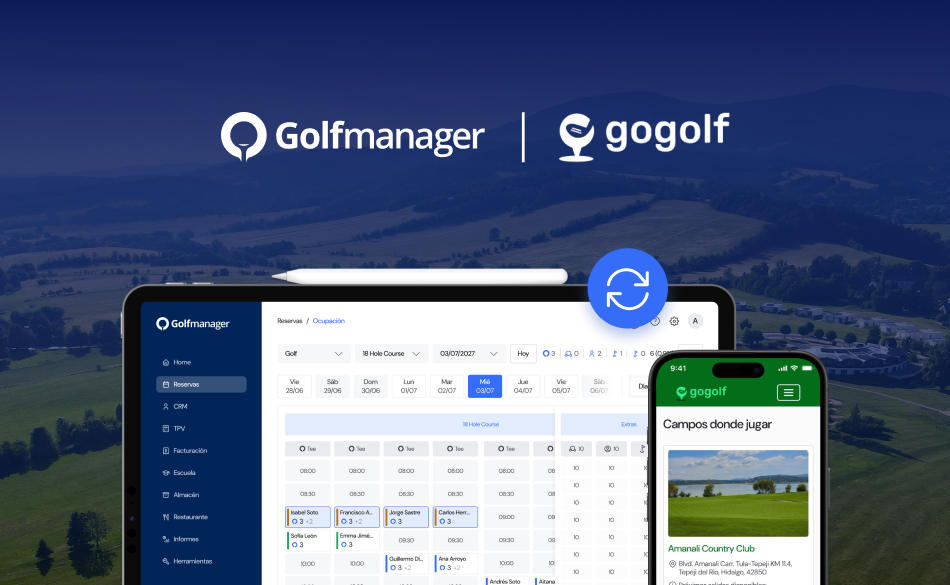
Golfmanager’s OTAs Connection module keeps your tee sheet as the single source of truth. It connects via API to golf-specific OTAs and tour operators, including platforms like GF365, LeadingCourses, and OnTee, so inventory updates automatically across every channel the moment a booking happens. There’s no manual reconciliation, and no risk of a tee time being sold twice.
Turning OTA Bookings Into Direct Customers
Relying on an OTA without a plan to convert its customers creates exactly the dependency clubs should avoid. The less a course invests in its own booking experience, the more it needs the OTA to fill its tee sheet, and the harder that dependency becomes to unwind later.
Capture golfer information at check-in regardless of how the booking arrived, and feed it into your CRM alongside every other customer record. A golfer who found you through an OTA this month is still worth marketing to directly next month.
Offer a modest incentive for booking direct next time: a small discount, or early access to a future date, mentioned at check-in or in a follow-up email. The goal isn’t to shame OTA bookings. It’s to give a golfer who already enjoyed their round a clear reason to skip the middleman next time.
Consider a golfer on a weekend trip who books a Tuesday afternoon round through an OTA because it showed up first in a search for courses nearby.
At check-in, staff asks for an email address to send the digital scorecard, the same step every golfer goes through regardless of how they booked. That email lands in the CRM next to the booking source. Three months later, when that golfer is planning another trip to the area, a direct email with a modest loyalty discount reaches them before they open the OTA app again. The second visit costs the club nothing in commission.
Measuring Whether OTAs Are Actually Worth It
Without clear metrics, it’s easy to assume OTAs are either essential or a waste of margin, with no real evidence either way. Golfmanager’s Reports module turns that assumption into an answer.
Track what share of total tee sheet inventory moves through OTAs versus direct channels, and whether that share is growing or shrinking.
Compare net revenue per channel after commissions and discounts, not just gross bookings, since a high-volume OTA channel can still underperform a smaller direct channel on actual profit.
And track how many golfers acquired through an OTA go on to book directly within the following months. That’s the clearest sign the funnel strategy is working.
Quick Best Practices
- Keep OTA-listed inventory limited to genuinely low-demand hours, not your full open tee sheet.
- Review commission and deal terms at least once a season, since platform terms shift over time.
- Never let an OTA-listed price undercut your own website’s rate for the same tee time.
- And treat every OTA booking as a lead for your direct channel, not just a one-off transaction.
The clubs winning this balance aren’t the ones avoiding OTAs entirely, and they aren’t the ones handing over their whole tee sheet either. They’re the ones using OTAs deliberately, for the inventory that actually benefits from it, while building a direct channel strong enough that fewer tee times need the discount in the first place.
FAQs
What is an OTA in the context of golf course bookings?
An online travel agency, such as GolfNow, GF365, or LeadingCourses, is a third-party marketplace where golfers search for and book tee times across many courses, typically in exchange for a share of the booking or a set number of discounted tee times.
How do golf OTAs typically get paid by courses?
Rather than a flat commission, many platforms use a model where the course gives up a set number of tee times per day, often one or two, to be sold through a discounted deals program, with the platform keeping the revenue from those specific slots.
What’s the real financial comparison when evaluating an OTA booking?
Not an OTA booking against a full-price direct booking, but an OTA booking against an unsold tee time that generates no revenue at all. A discounted round filling otherwise empty inventory still beats zero revenue.
How can golf courses protect margin while still using OTAs?
By releasing only low-demand time blocks to OTA channels through dynamic pricing rules, while reserving high-demand hours for direct booking at full rate.
Why does real-time inventory sync matter for OTA distribution?
Without it, a tee time sold on one channel can still appear available on another, creating double bookings. Real-time sync, usually via API connection, keeps the tee sheet as a single source of truth across every connected channel.
Which Golfmanager modules support OTA distribution strategy?
OTAs Connection synchronizes tee sheet inventory automatically across external channels like GF365, LeadingCourses, and OnTee. Dynamic Pricing controls which time blocks get released to OTAs versus reserved for direct booking. Reports tracks revenue and booking share by channel to measure whether the OTA strategy is working.
Explore Golfmanager’s OTAs Connection module or schedule a demo to see how to distribute tee times through OTAs without losing control of your margin.